What happened in Joliet
In 2005 the City estimated ash made up about 20% of its street trees and dropped ash from its approved planting list. It adopted an EAB Management Plan on May 16, 2011 (Joliet Forestry). In 2012 the city arborist said up to 80% of city-owned ash might be infested (Patch), and in 2013 the City planned to remove every parkway ash in the Warwick and Grand Prairie subdivisions, more than 1,000 trees that year (Patch).
Save it or take it down?
Treatment only makes sense for a healthy, valuable ash. Illinois guidance generally says treat trees with most of their canopy intact, and that an ash that has lost more than half its canopy is unlikely to recover (U of I Extension; Illinois Dept. of Agriculture; Morton Arboretum). Trunk injections must be done by a licensed applicator (IDOA).
Signs of EAB
- Thinning from the top of the crown down.
- Small D-shaped exit holes in the bark.
- Woodpeckers stripping bark ("blonding").
- Sprouts bursting from the lower trunk.
- S-shaped tunnels under loose bark.
Why dead ash is a different job
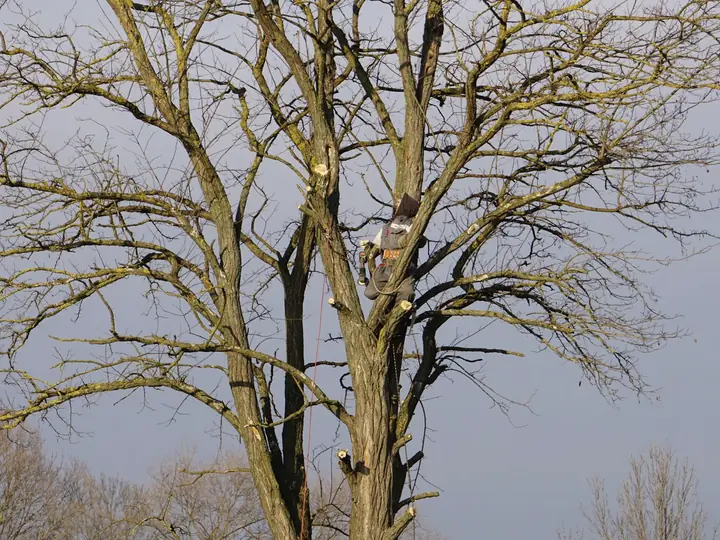
Ash dries out and gets brittle after it dies, so branches can snap unexpectedly while being climbed. Many crews prefer a lift or crane on long-dead ash instead of climbing. Tell the crew how long the tree has looked dead; it affects how they plan the job.
Parkway ash
A painted number on a parkway ash means it's on the City's removal list; the City says removal can take 5 to 7 years after marking (Joliet Forestry). Parkway ash is the City's job, so call 815-724-3650 if one looks dangerous rather than waiting.
Dead ash gets brittle, so crews often switch from climbing to a lift, which changes how the job is planned.
The City's own EAB rules
Parkway ash
The City is not treating parkway ash. Homeowners may treat a parkway ash, but must give the City proof of the work and who will do it (Joliet Forestry).
Who can treat
Joliet says treatment must be applied by a certified arborist licensed with the City of Joliet to do tree work (same page).
Timing
The City notes soil-applied imidacloprid works best applied mid-April through June, earlier for bigger trees (same page).
How fast
An infested ash typically dies in about three years, per the City (same page).
Treat or remove?
University of Illinois Extension says ash that have lost more than half their canopy are unlikely to recover, even with treatment (U of I Extension). Healthy ash can be protected, but treatment has to be repeated, and in Illinois injections must be applied by a licensed applicator (IDOA). If a dead ash stands near the house, garage or a play area, don't wait: dead ash dries out and drops limbs without warning.
Questions to ask a crew
How much canopy has this tree lost? Is it treatable?
Can you climb it, or does it need a lift because it's brittle?
Are you licensed with the City for tree work and treatment?
Will you remove the stump and haul the wood? (Ash wood moves EAB.)